High-Rise Labs Today

Presentation delivered at London Lab Live, May 2026
Located somewhere out of town, three to five stories high, painted in fifty shades of grey. Meager landscaping, few places around to meet somebody for a decent lunch. This is where the new high-earning scientific creative class is working on groundbreaking inventions, creating new materials and medications, and helping produce and preserve energy. Meanwhile, the old office workforce class is holding on to the best real estate in the city, enjoying fine lunches and pondering layoffs.
This long-standing scenario is beginning to change. Lab buildings, at least some of them, are leaving the suburbs and moving downtown. They are gaining height and becoming increasingly fit -compact, flexible, and attractive to tenants. How do they do that? Can every lab building follow?
Here is a look at four quite different high-rise lab projects in Switzerland and the UK – one already built, one in construction, one on the drawing board, and one being patented.
All projects are brand new; it is too soon to speak of what worked and what didn’t in the long term. However, all four carry certain features that could be useful for future lab high rise projects.
These features are modularity, compactness and plant strategy.
The three built or planned projects also share a piece of DNA that makes them somewhat less athletic - less compact - than they could be: they all have labs and offices on the same floor. The fourth project, the Club Lab patent, attempts to alter that DNA.
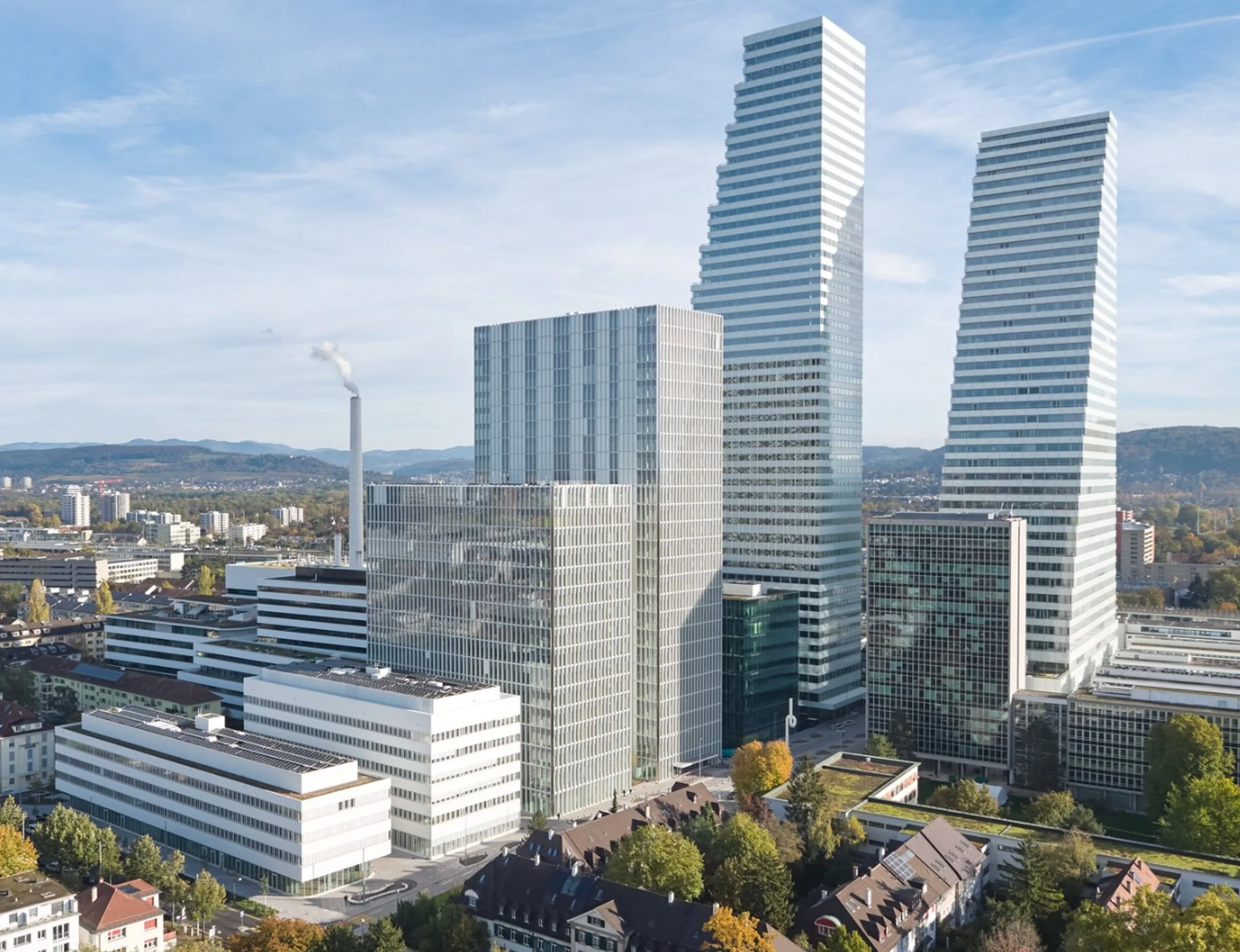
pRED / Image: Roche / HdM

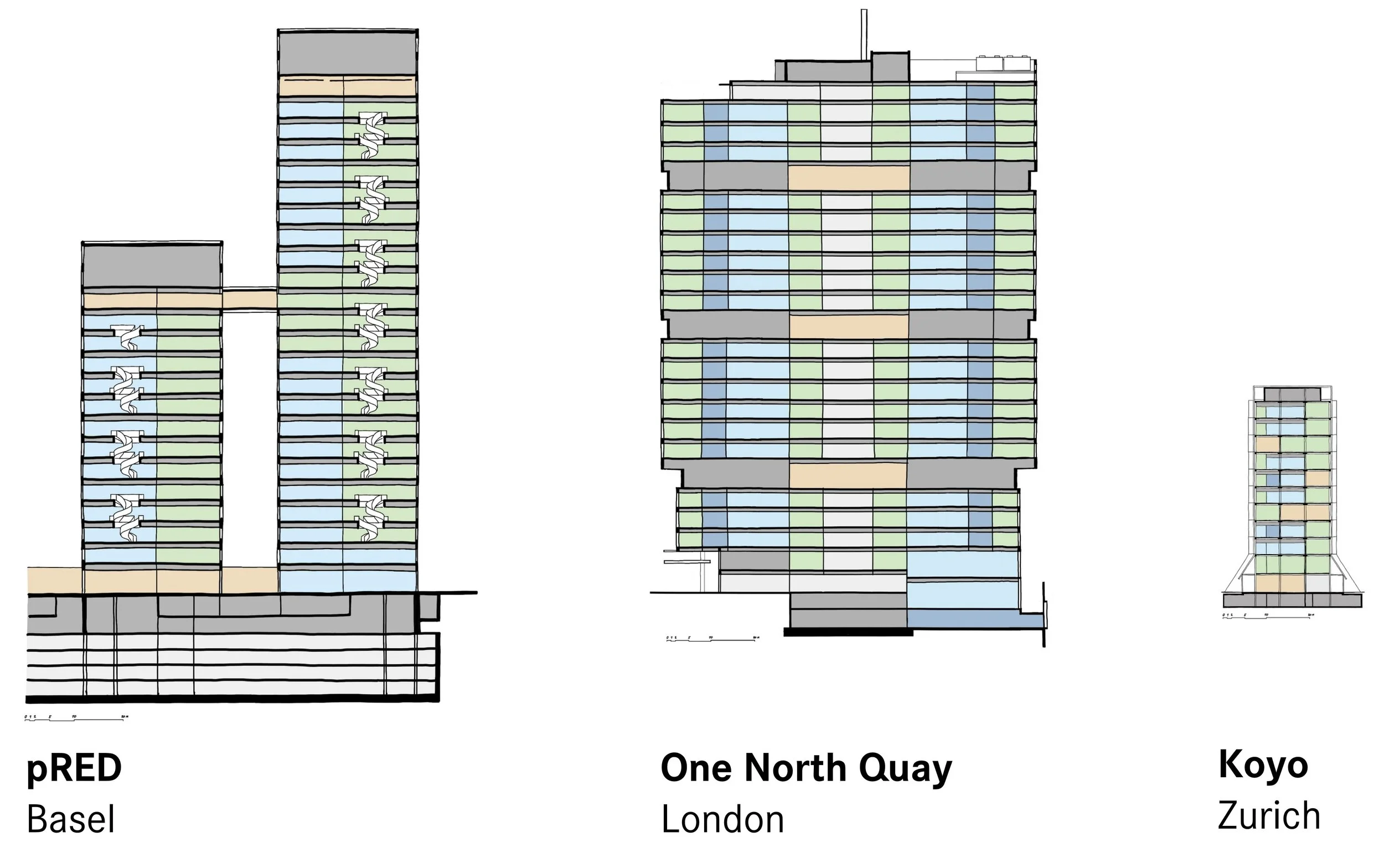
pRED section
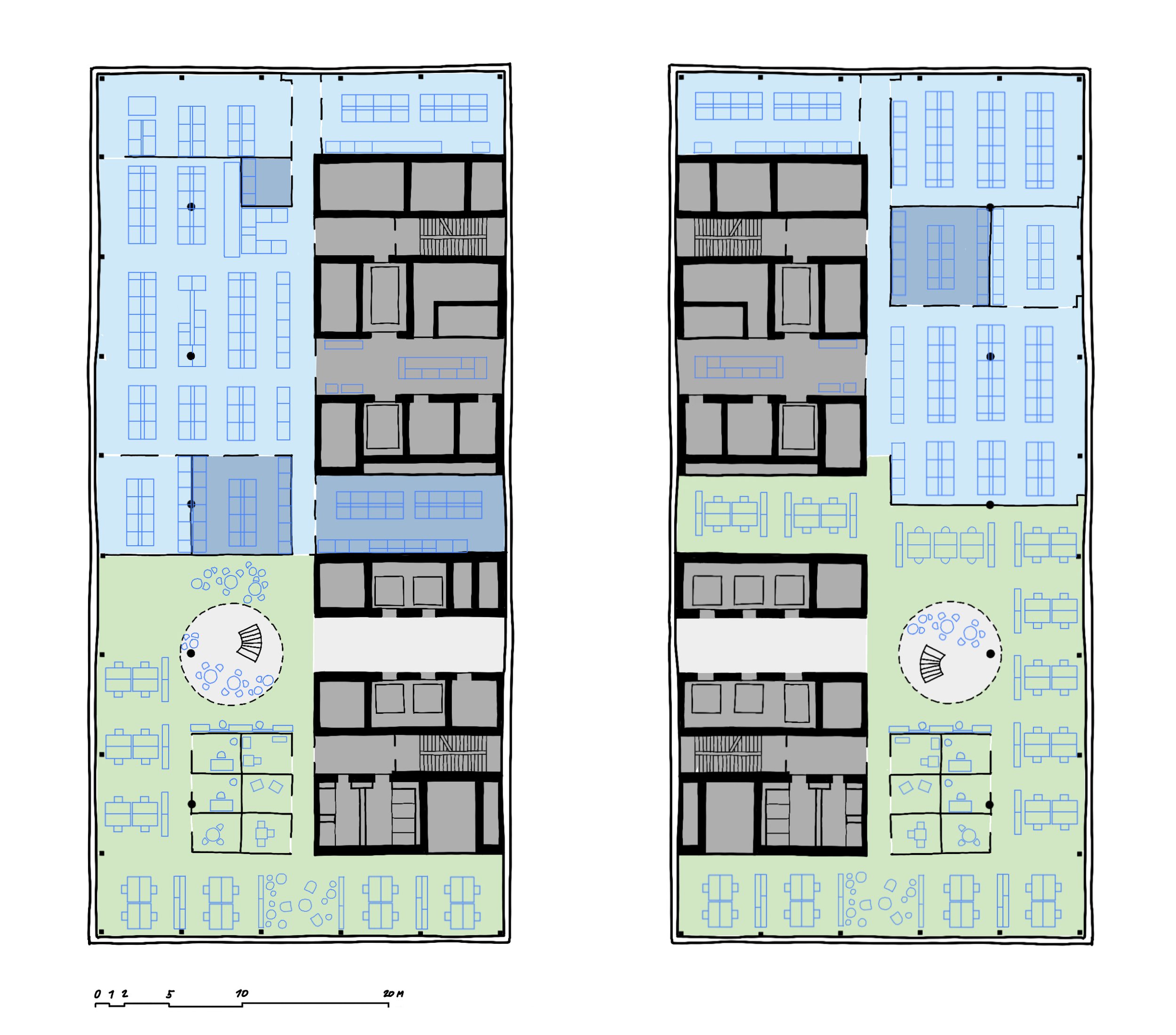
pRED plan
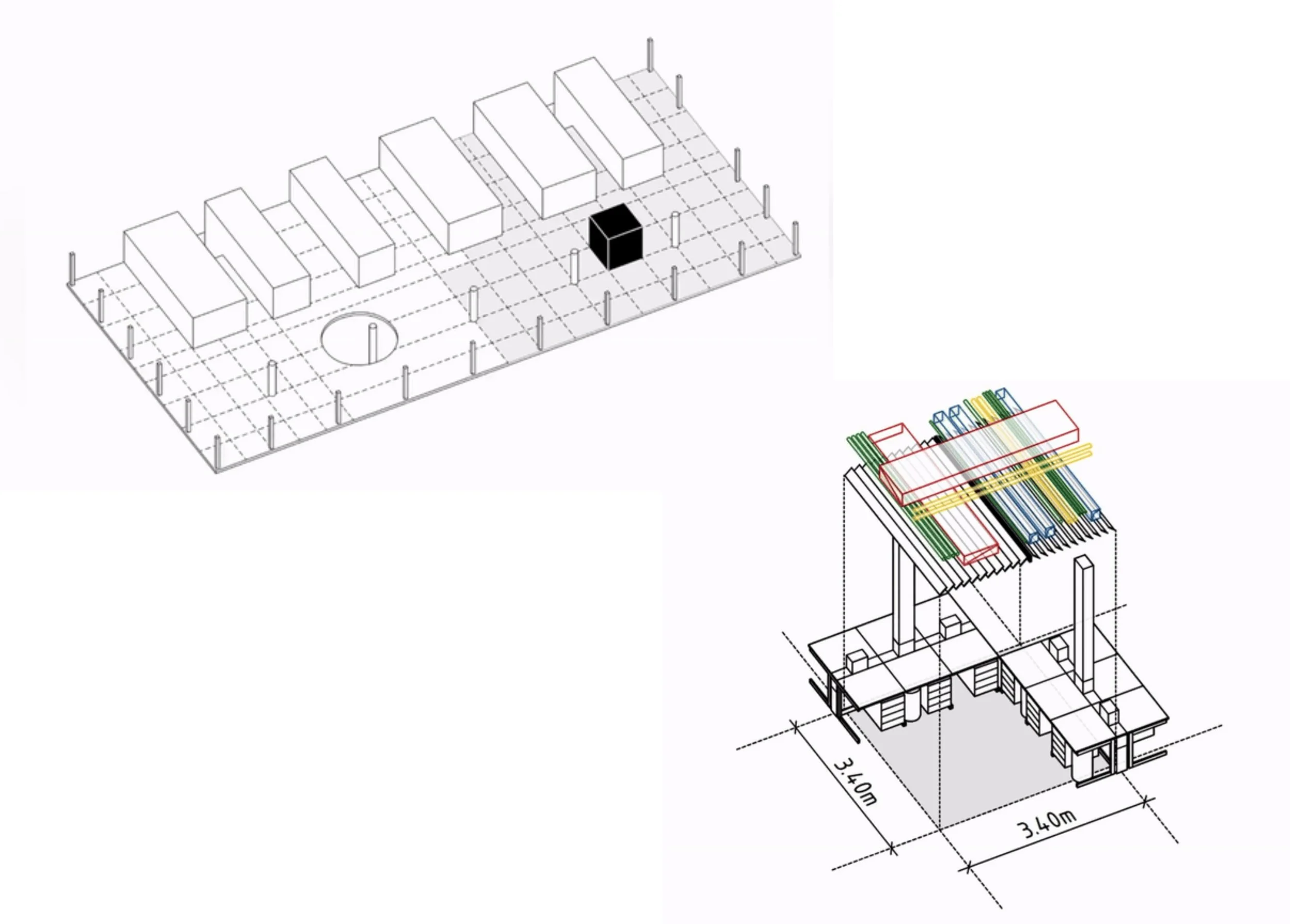
pRED module / Image: Roche / HdM
pRED by Roche in Basel
Roche (with the architects Herzog de Meuron) has recently completed two laboratory towers in central Basel, Switzerland. Set alongside other research facilities and embedded in a lively international city, pRED allows its users to benefit from urban amenities while staying closely connected to the wider research campus.
The 16- and 26-story towers are mirrored twins in plan and are linked by a bridge. Laboratory and office functions share the 1’600 m² floor plates. Open stairs connect collaborative areas across three-floor blocks, forming “neighborhoods” of roughly 140 scientists. Central plants serving the towers occupy large technical floors below grade and at the top of each tower.
The shafts within the two service cores (one per tower) are substantial, reflecting the ambition of a fully “lab-ready” concept. Because the plants are centralized, not only exhaust air but also fresh supply air must be routed from the bottom to the top of the building, driving up riser space and reducing usable floor area.
Each floor is laid out on 3.4 m square modules that can be fitted out for laboratory or office use. At commissioning, the floors were split roughly evenly between lab and office functions.
Overall, pRED performs well on modularity through its repeatable 3.4 m grid, but it is less convincing on compactness, as the twin service cores and full-height fresh-air risers required by the central plant consume a substantial share of each floor plate with only one useable side. The plants remain centralized rather than delegated to intermediate technical levels, so the scheme does not gain the shaft reductions that more distributed approaches can deliver.
If pRED demonstrates strong two-dimensional modularity but pays a penalty in core and riser area, One North Quay shows what happens when modularity becomes a repeatable vertical stack and the plants are distributed through the height of the building.
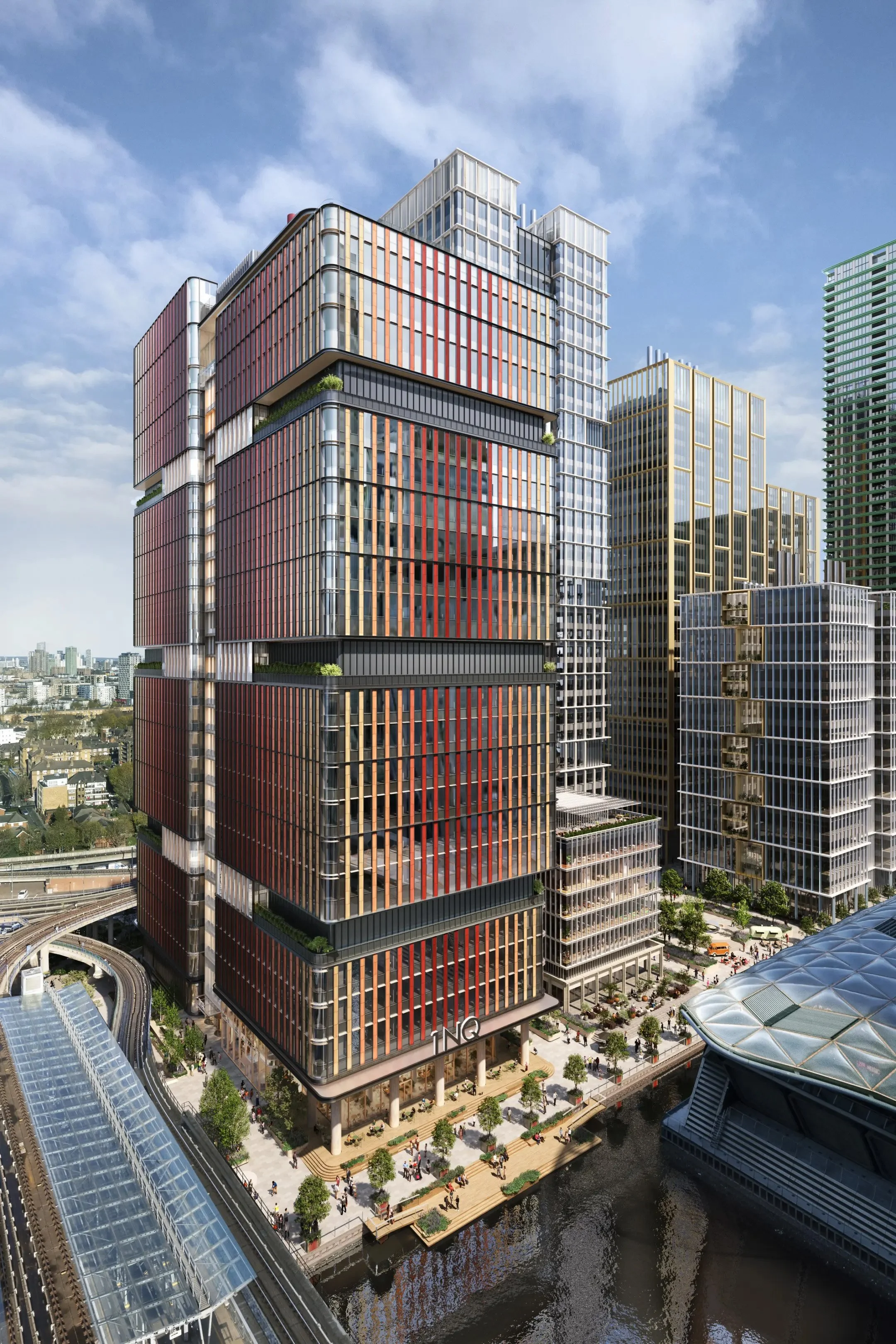
One North Quay / Image: Kadans / KPF
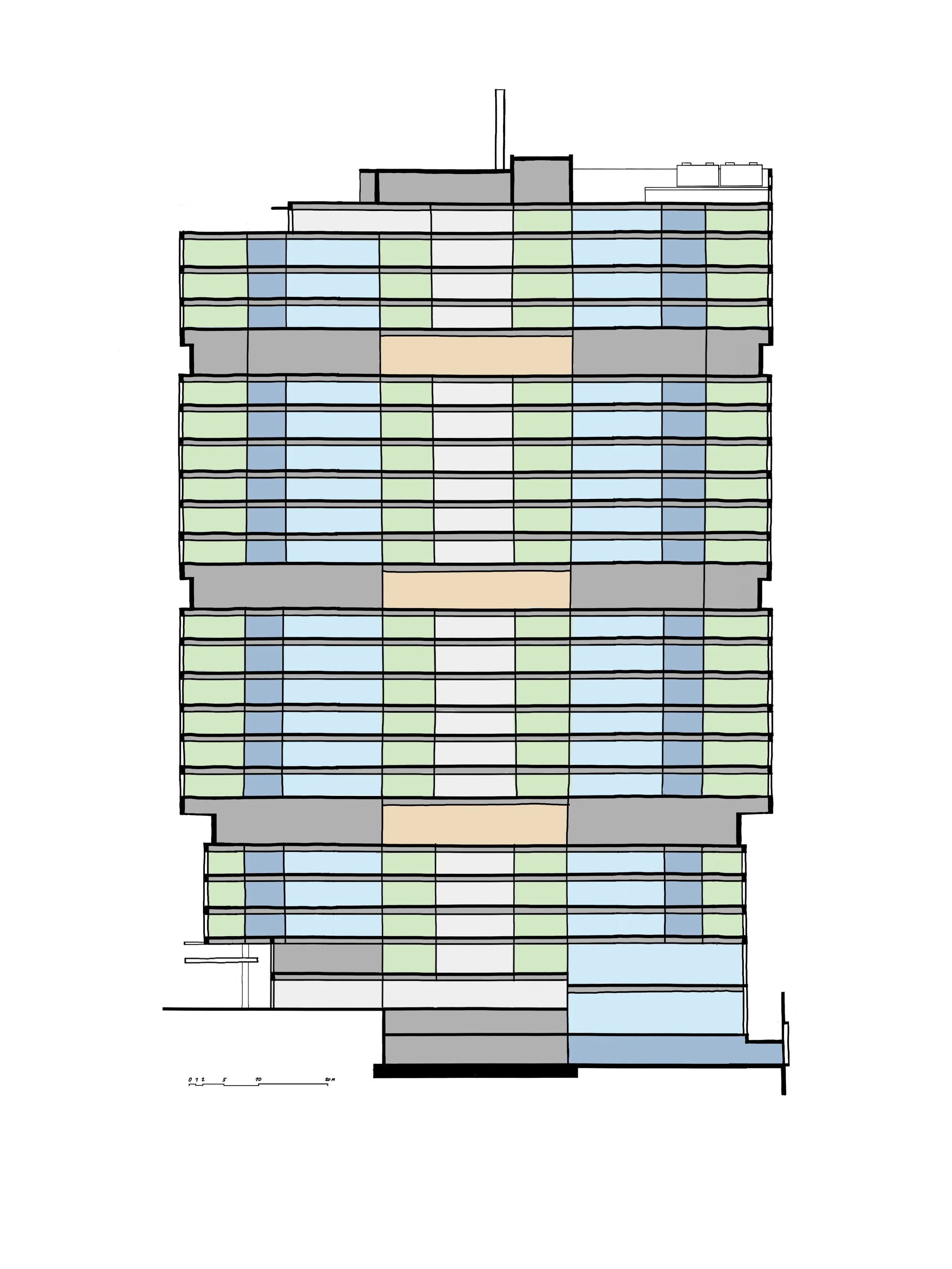
One North Quay section
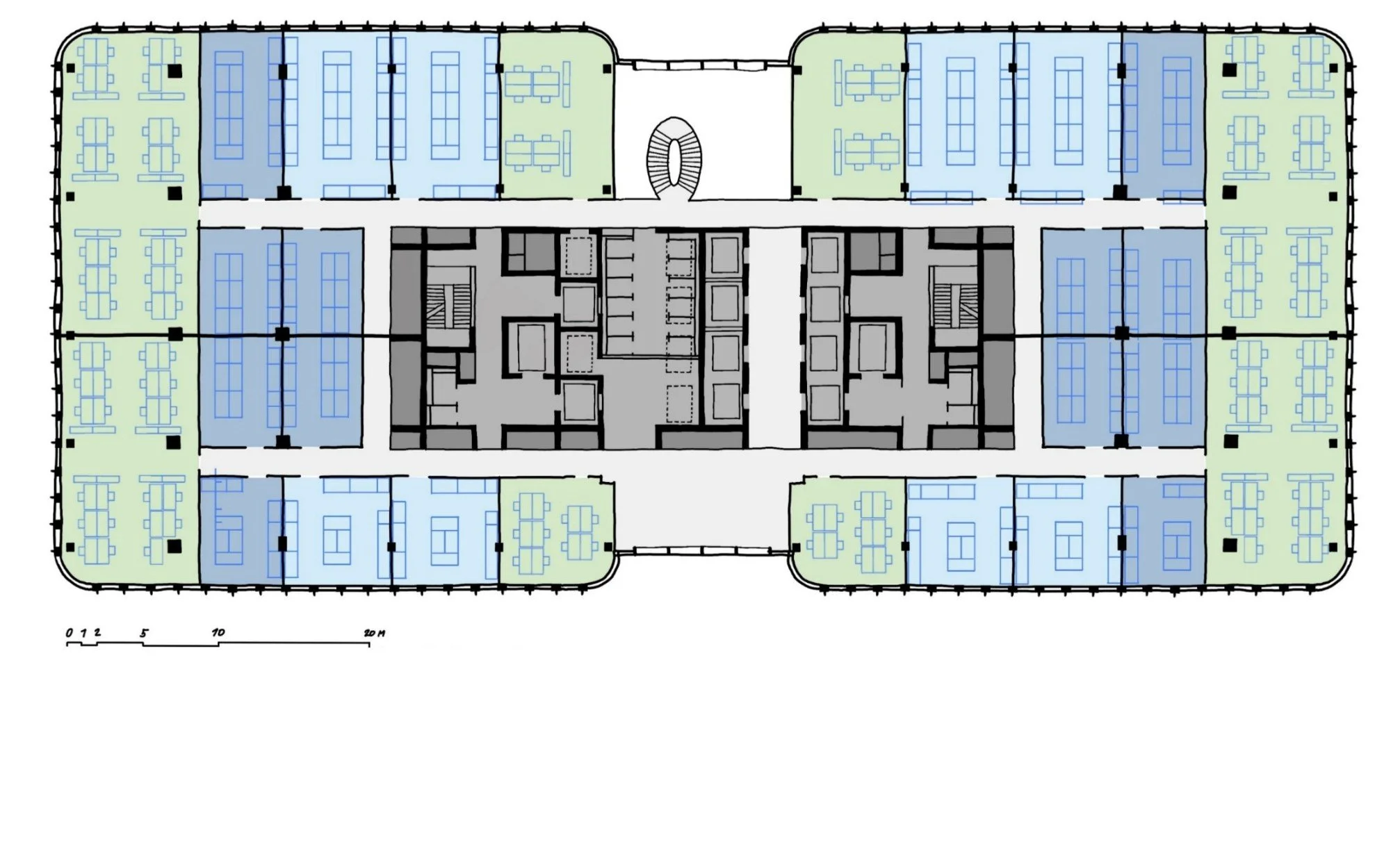
One North Quay plan
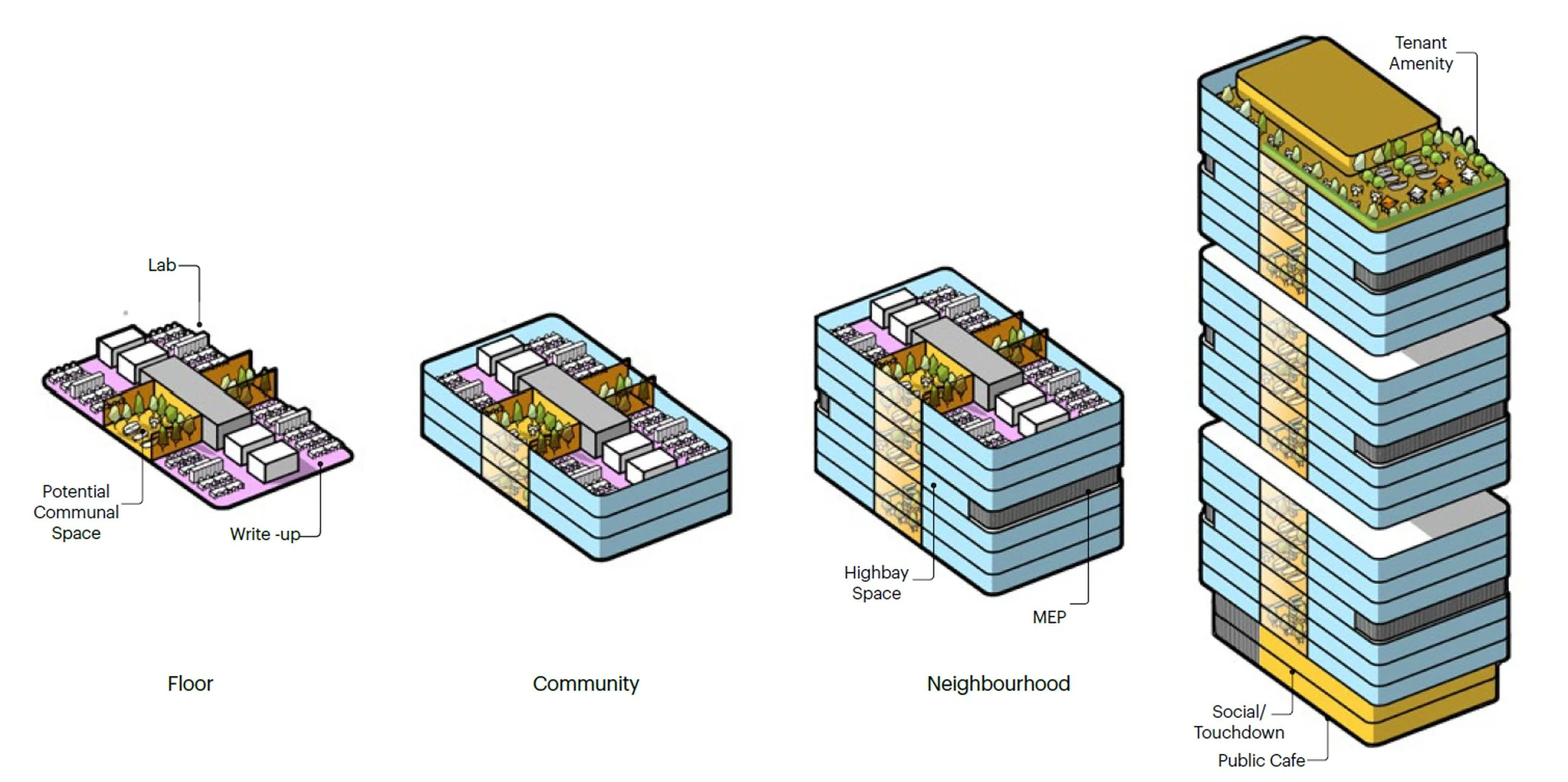
One North Quay / Image: KPF
One North Quay by Kadans Science Partner in London
One North Quay is a pioneer project: Europe’s largest life-science cluster consolidated into a single building, currently under construction in Canary Wharf. Developed from the 1980s onward as a model “downtown” for financial services, Canary Wharf has been dominated by office use. Over time, office supply became abundant and underused - while retail and leisure amenities grew underneath and around the towers. Kadans Science Partner’s vision is to establish a self-sufficient critical mass of life-science activity in one landmark building, while retaining the option to develop adjacent sites in the near future. The project leverages partnerships between Kadans as developer, the landowner and project partner Canary Wharf, and local authorities focused on employment opportunities for surrounding boroughs. For Kadans, it is a big - but not blind - bet, building on a track record proven across many European projects.
To accommodate 76’500 m² of research and office space in a single 23-story tower, KPF, the project’s architect, effectively stacked three six-story lab “buildings” vertically. Each is paired with its own seventh, technical floor, positioned between two three-story lab/office blocks referred to here as “Neighborhoods.” Within each Neighborhood, the three-story lab/office package is tied together by an open stair, creating a “community” sized for research groups of 100+ scientists - comparable in intent to Roche’s neighborhoods, but expressed as a vertical, repeatable unit. In this sense, modularity becomes three-dimensional.
ONQ also ticks a second high-rise lab principle: it avoids a single, oversized central plant. Instead, smaller decentralized plants serve each of the three Neighborhoods, with fresh-air intake occurring at those technical levels. This approach shortens supply-air routes and reduces the amount of floor area lost to full-height fresh-air shafts.
Overall, ONQ scores highly on modularity, because its three-story Neighborhood packages repeat vertically and integrate a dedicated technical level as part of the stack. It also performs well on compactness by concentrating a very large program into one tower - though the added technical floors inevitably introduce some overhead. And in terms of plant strategy, the project is a clear “yes” for a distributed approach: intermediate plants with local fresh-air intake drastically reduce the amount of floor area lost to shafts.
At the opposite end of the scale, Koyo illustrates how compactness can be achieved not by stacking a mega-program, but through footprint discipline and a site that is both transit-connected and adjacent to an existing life-science cluster.
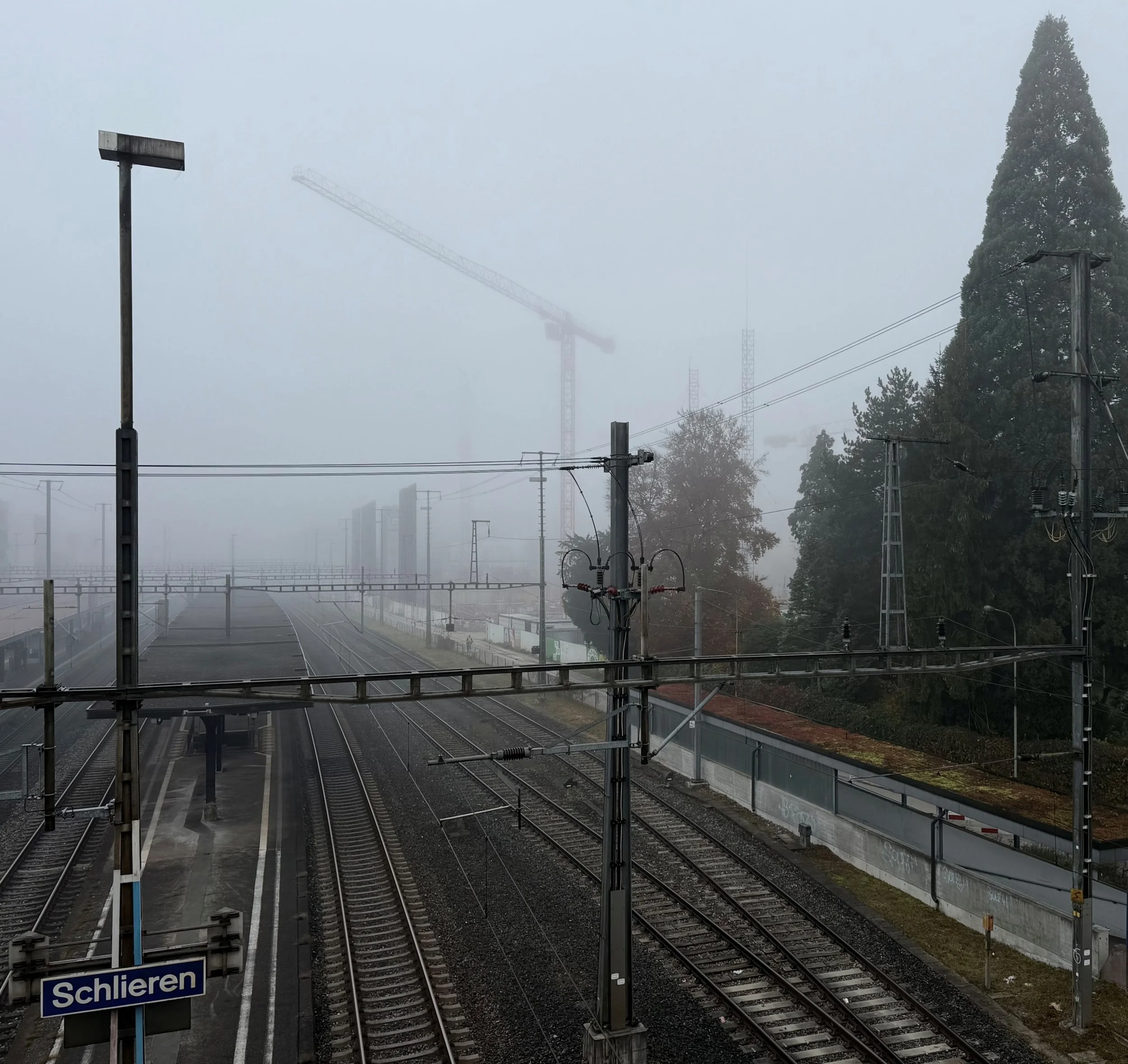
Koyo site in Schlieren, Zurich
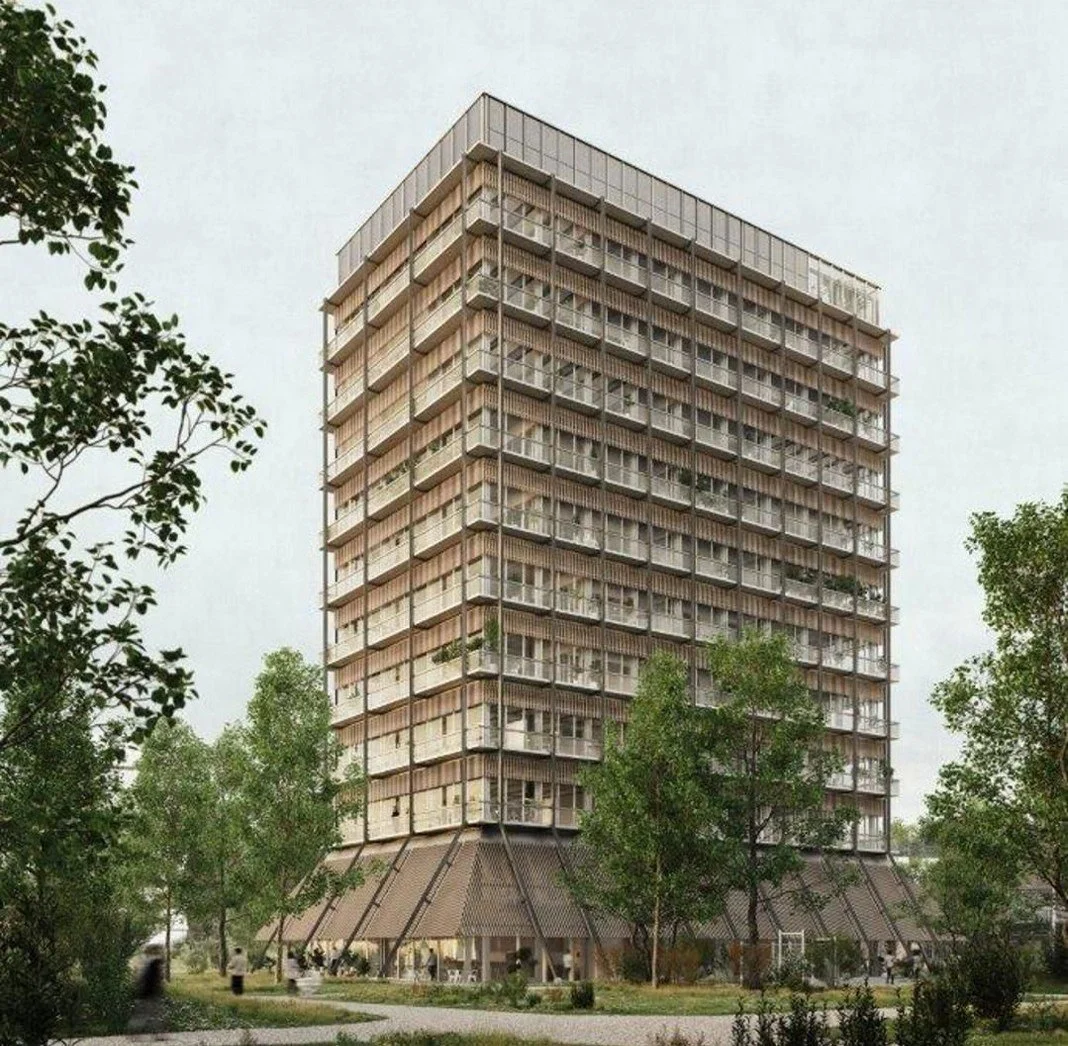
Koyo / Image: Geistlich Immobilia
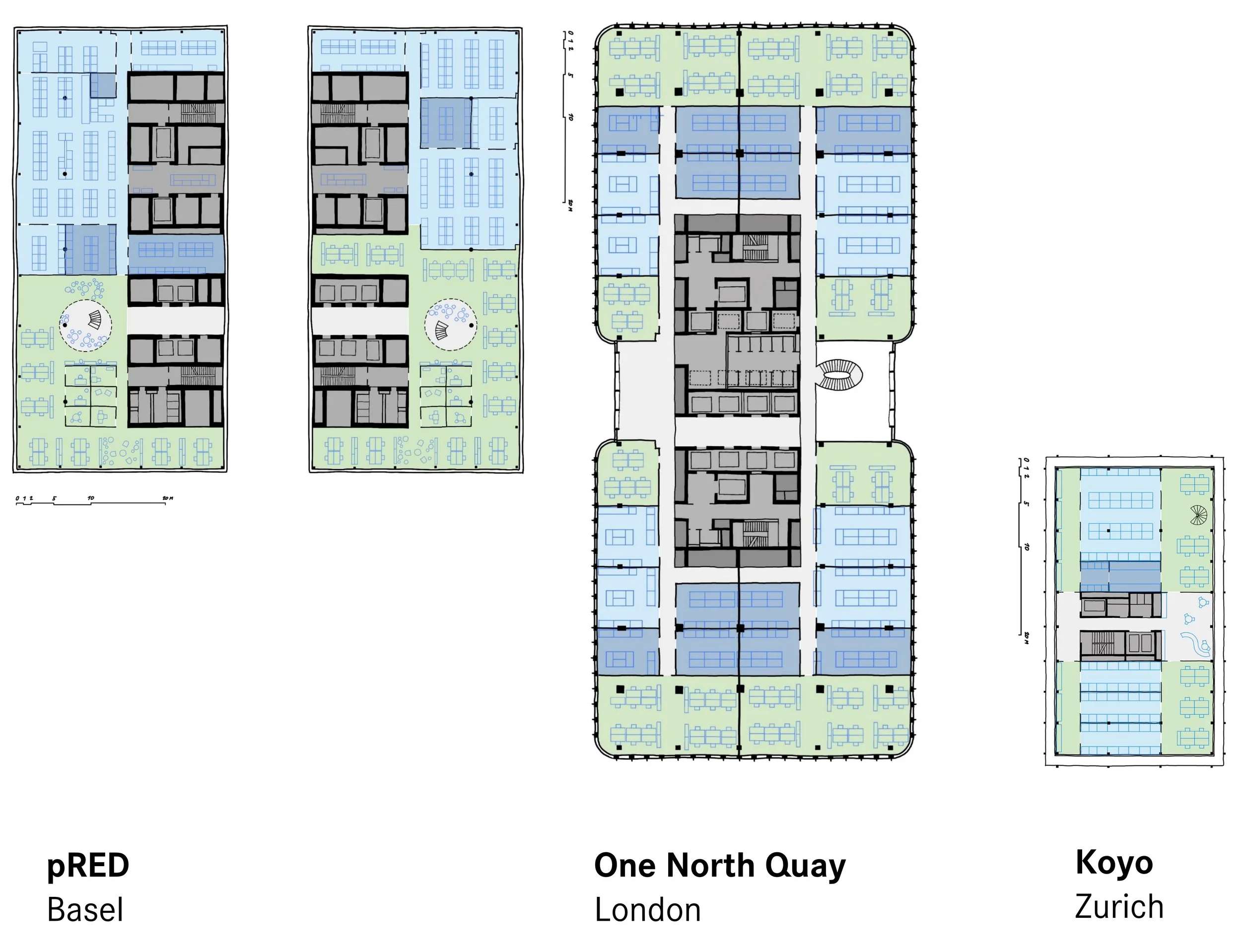
Project plans in the same scale
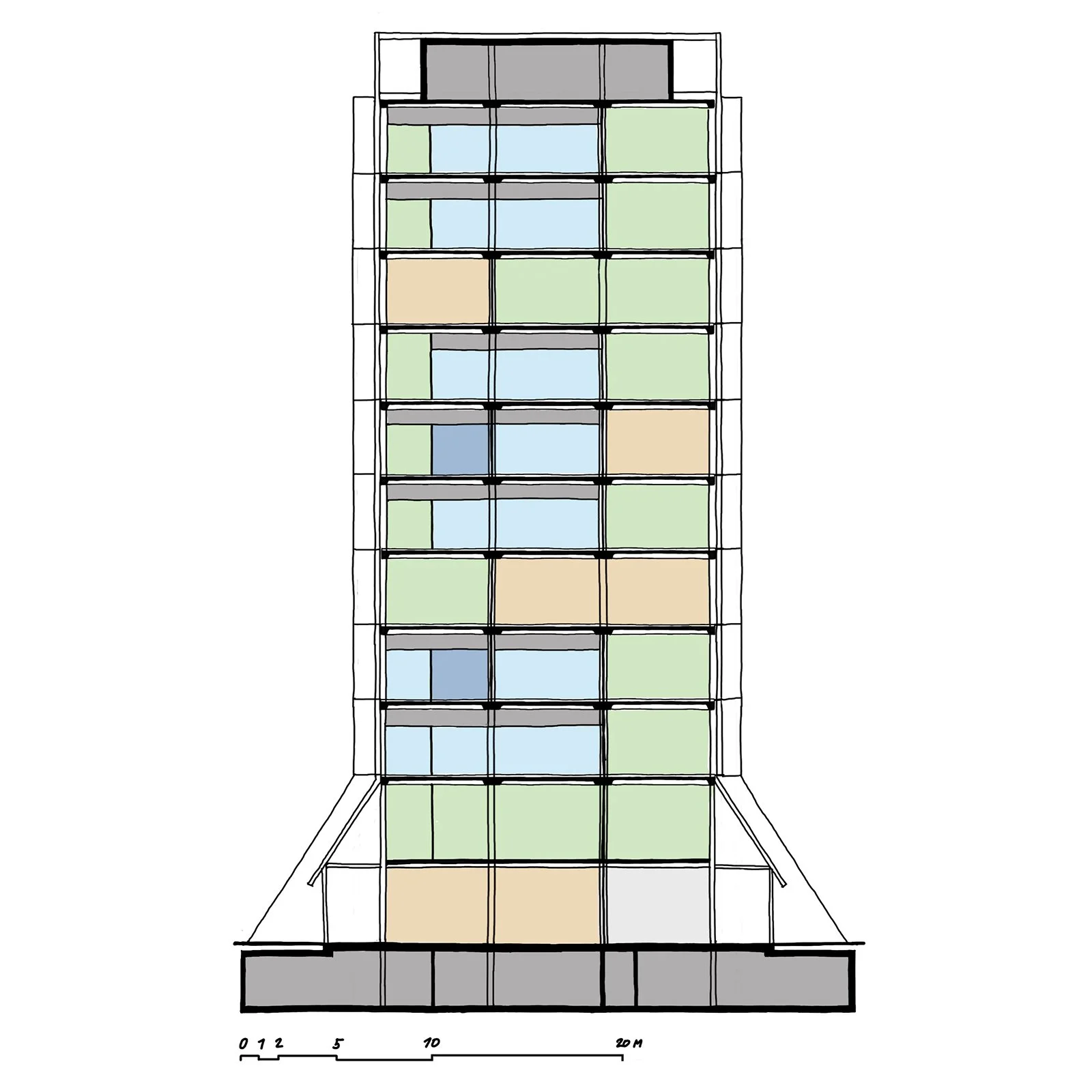
Koyo section
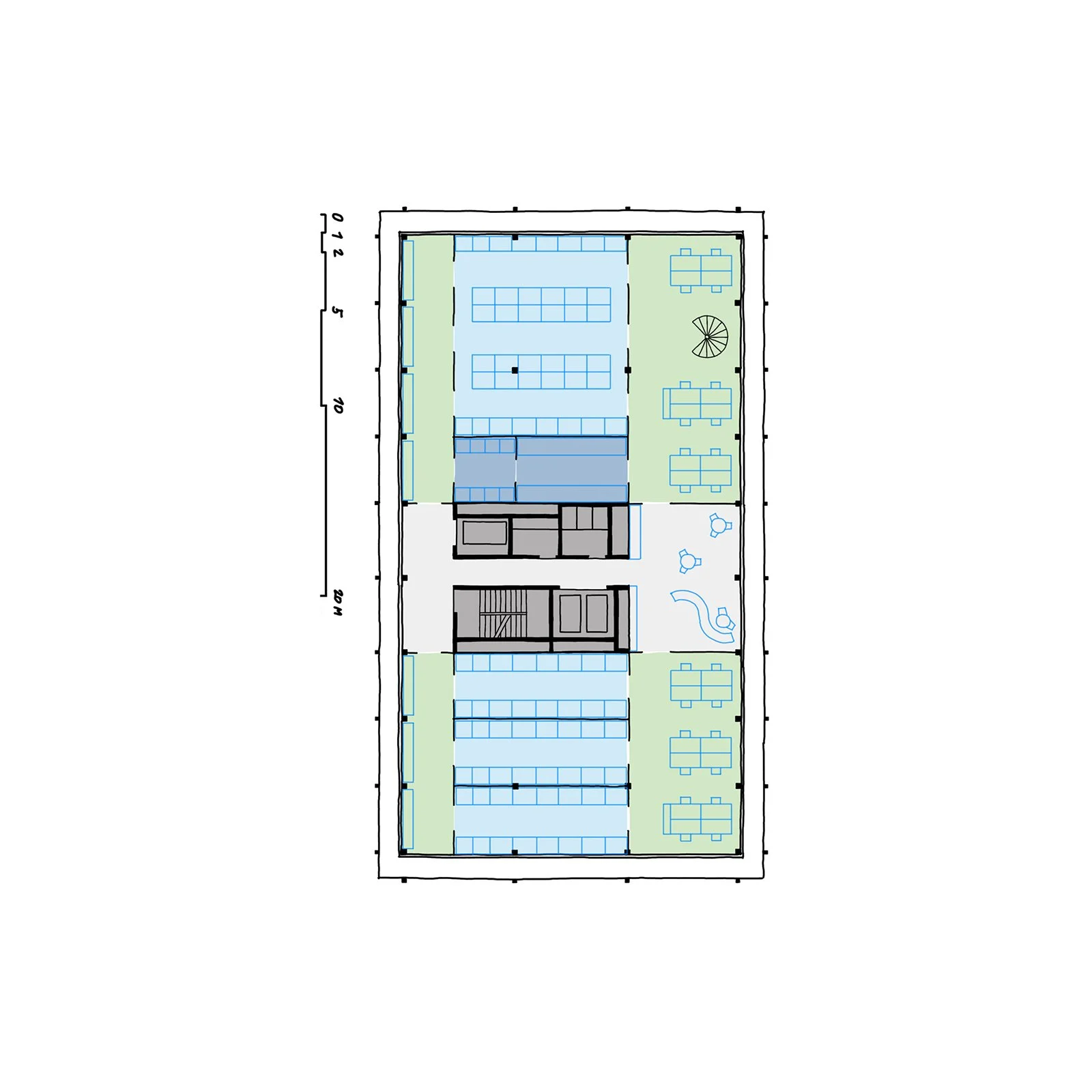
Koyo plan
Koyo by Geistlich Immobilia in Zurich
The third feature – compactness - is best illustrated by Koyo, a boutique lab-tower project by Geistlich Immobilia and Waldrap architects. The scheme has recently received a building permit in Schlieren, just outside Zurich, and will join an established commercial life-science cluster that serves the region’s growing med-tech industry. With a footprint of roughly 600 m², Koyo is far smaller than the other projects, yet it aims to offer comparable capabilities: a mix of lab and office space, plus collaborative areas that can be flexibly connected. Like pRED, Koyo relies on centralized plants, with technical rooms below grade and at the top of the building.
Set within a primarily residential development, Koyo makes efficient use of a very small plot and keeps the ground around the tower open to be used as a park. This is where a compact high-rise approach adds value: it allows owners to develop even the smallest well-located sites. In Koyo’s case, the tower sits about a minute from the commuter rail station with abundant housing options around and within walking distance of other life-science buildings.
Overall, Koyo wins on compactness: its economical footprint and transit-adjacent setting demonstrate how lab towers can take advantage of attractive urban plots without sacrificing outdoor space. On modularity, it is a program-level “yes” (flexible lab/office mix and connectable collaboration zones), even if it is not expressed as a vertically repeatable lab/plant stack like ONQ. In terms of plant strategy, Koyo follows a centralized approach with technical rooms below grade and at the top.
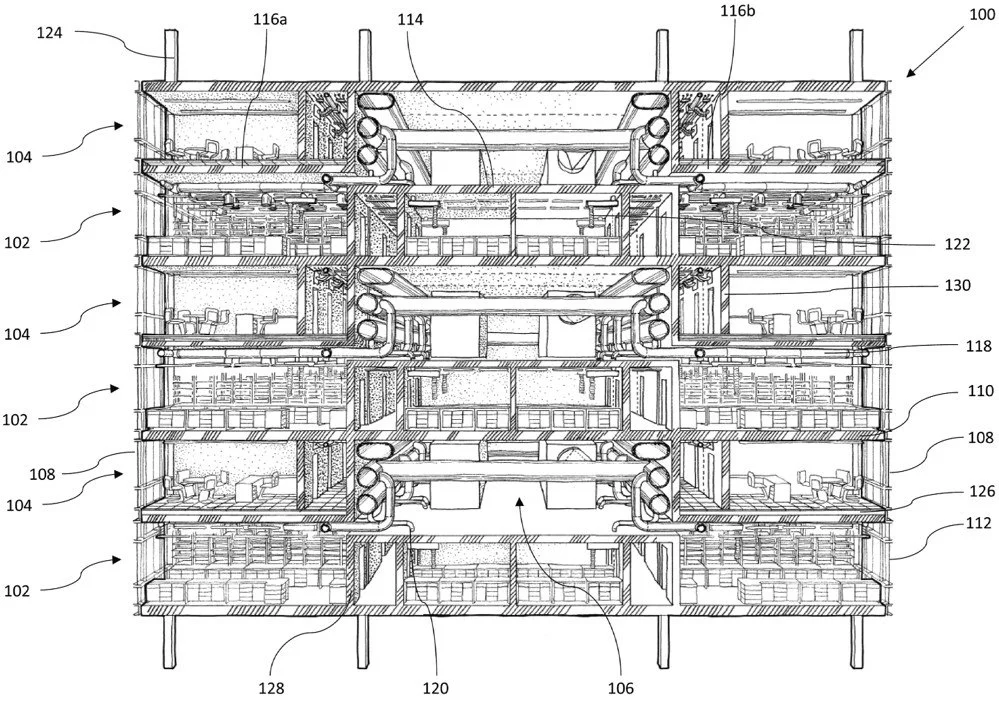
Club Lab / patent pending GB2302042.3
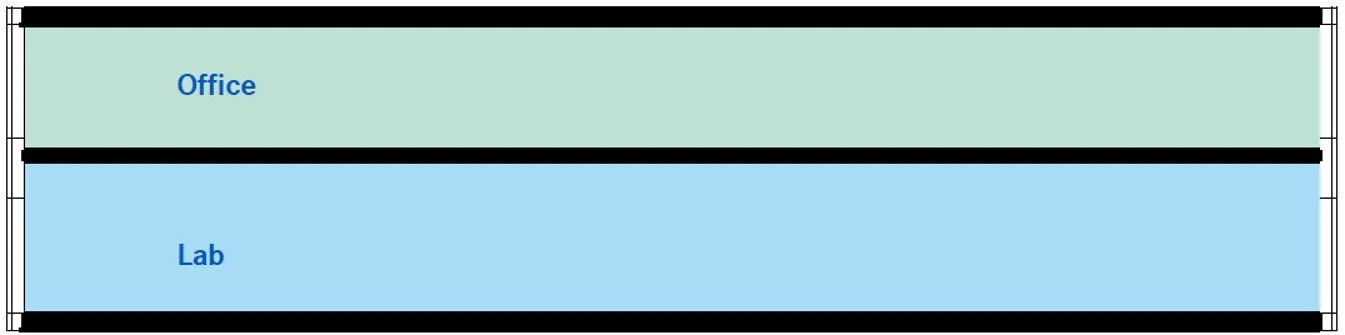
Alternating Lab and Office floors
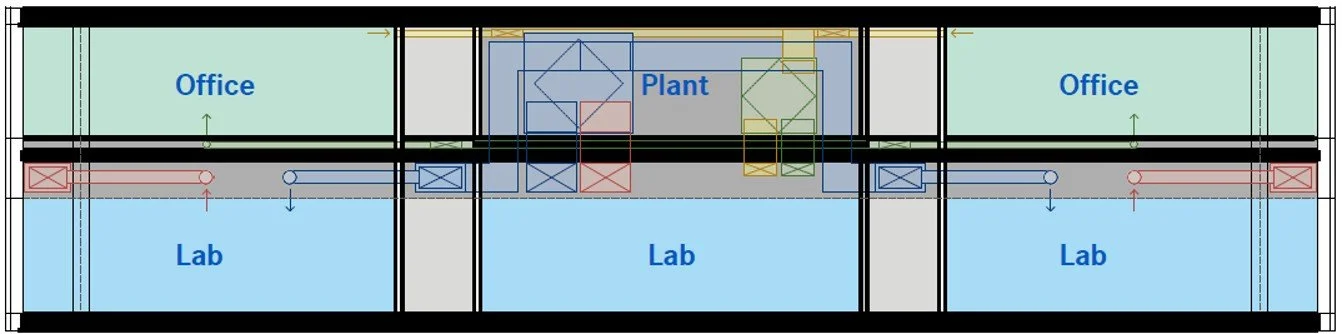
Mini-Plants on Office floors
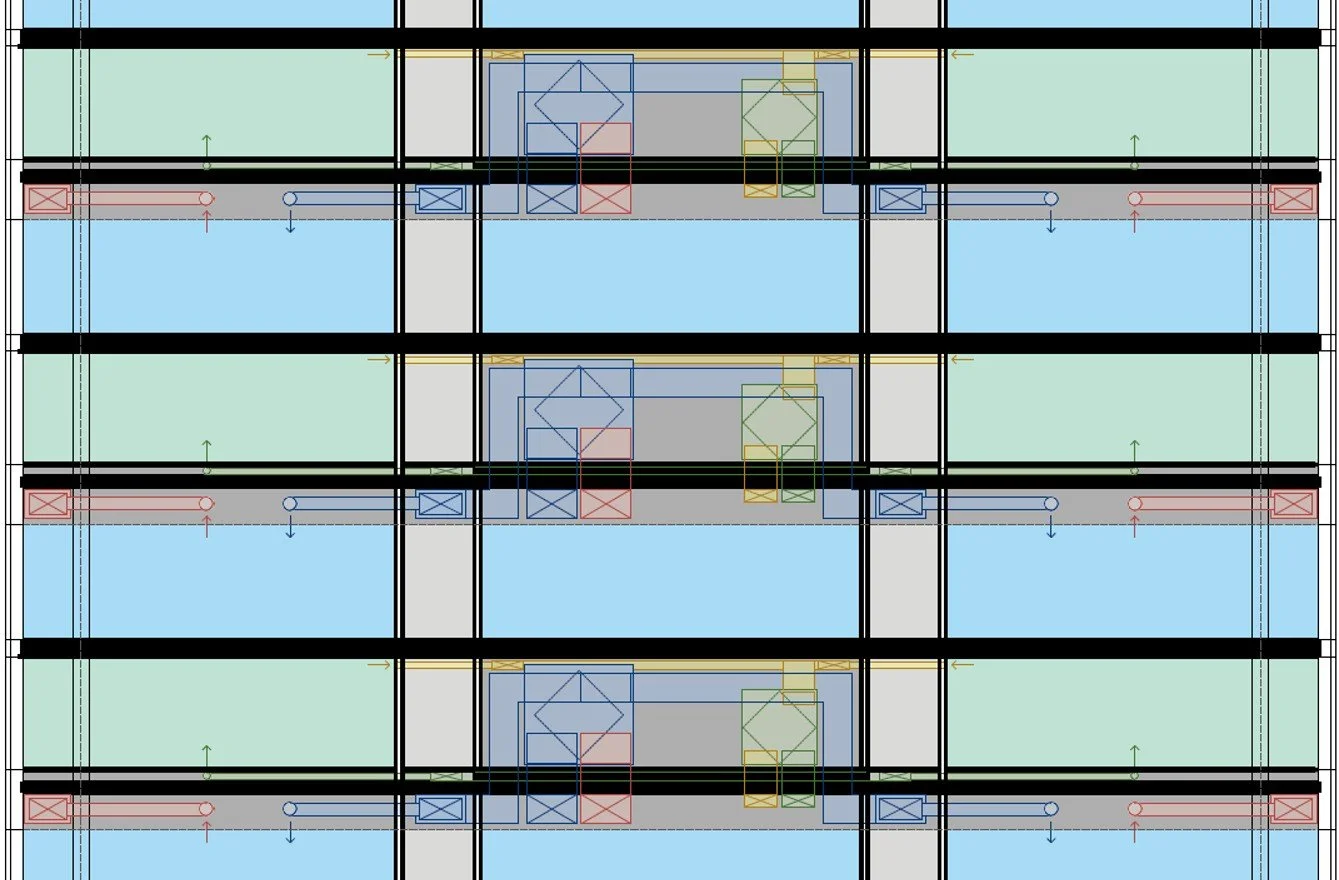
Stackable Lab-Office pairs
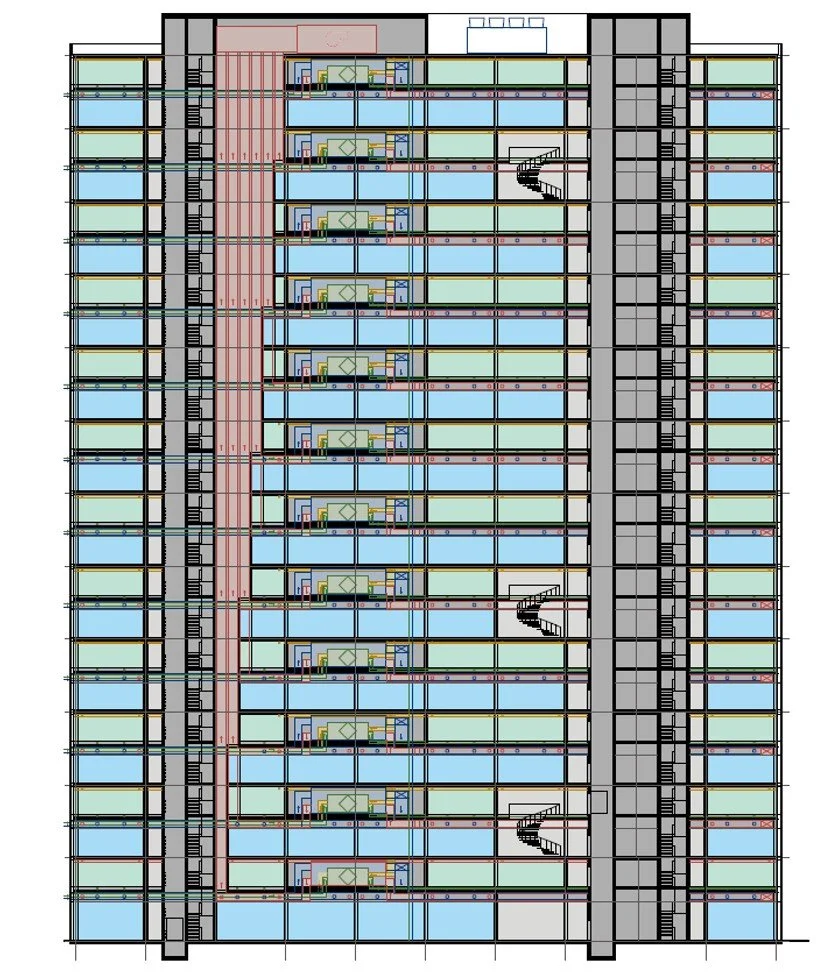
High-Rise Lab
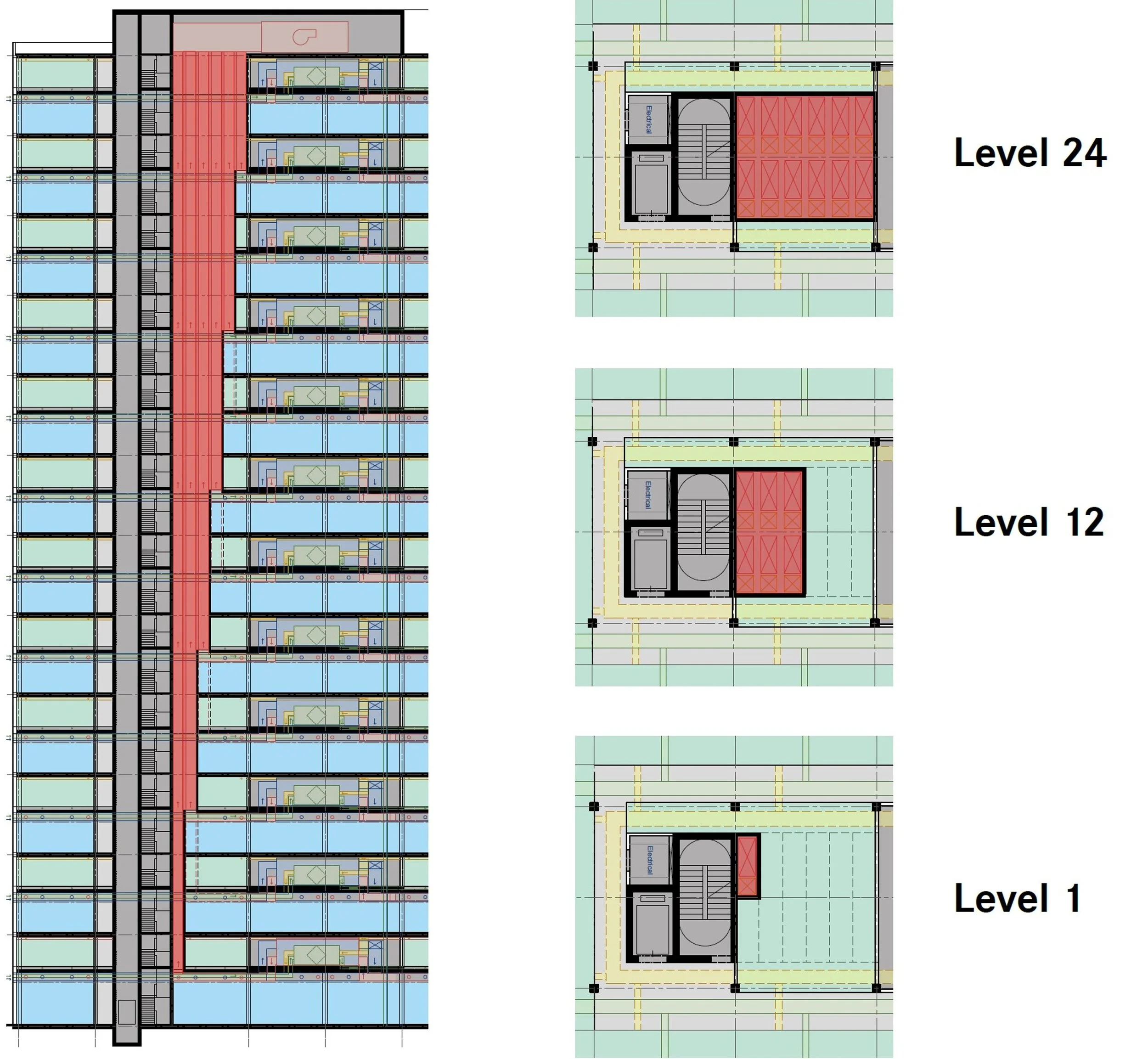
Exhaust shafts only needed - shaft area cut by half
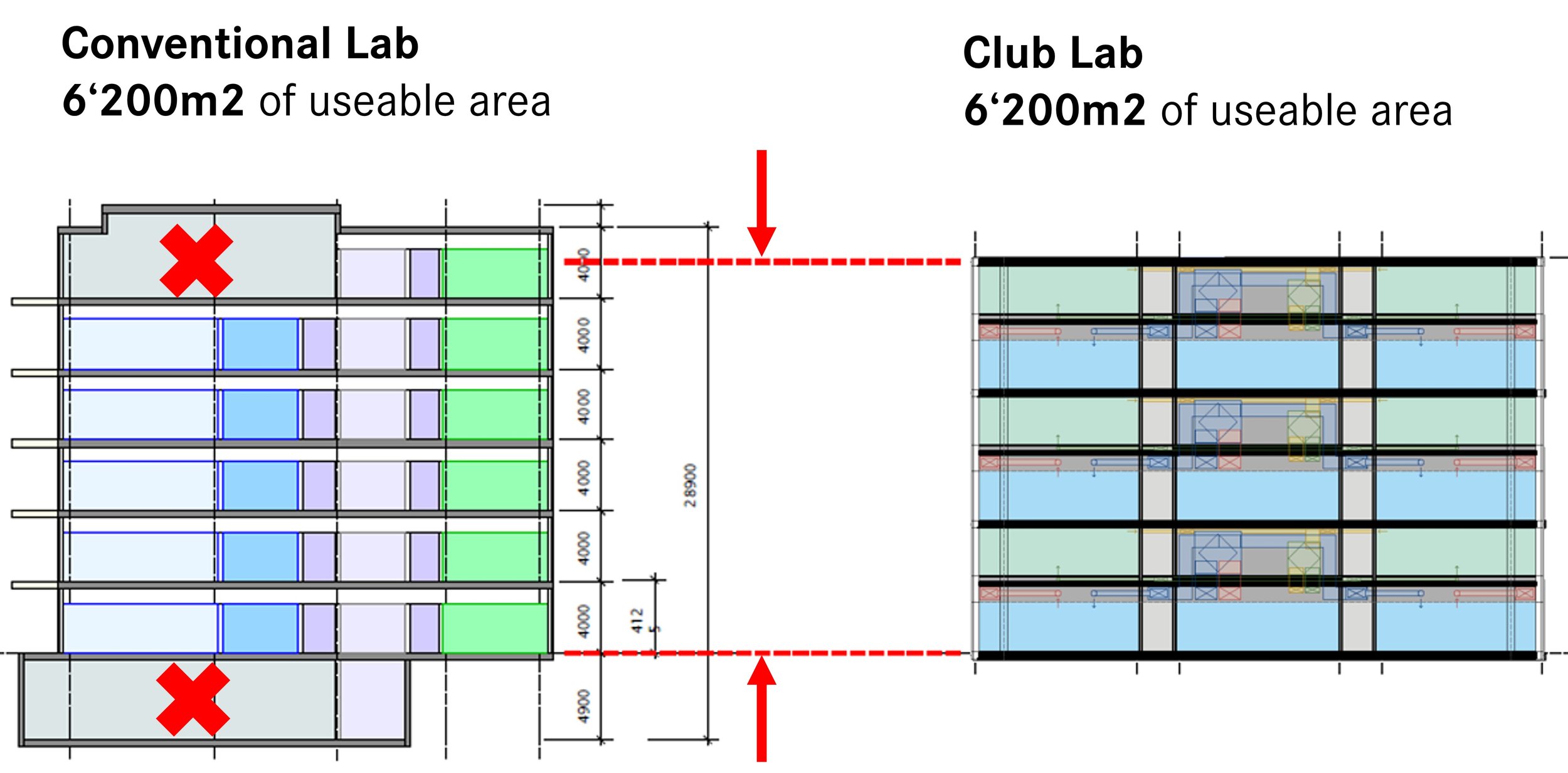
15% less building volume, no underground floors, fits one more floor per 8 floors built
Club Lab Patent
While working for more than ten years in university real estate, we had the chance to observe and reconfigure numerous laboratories. Over time, one pattern stood out: most laboratory buildings place labs and offices on the same floor - a strand of architectural DNA that the three projects shown here also share. Yet labs and offices are not perfect neighbors. Labs typically require greater clear heights for extensive overhead air-handling and services, while offices can work with lower ceilings but need raised floors for data and power cabling. Their building systems differ significantly as well. Combining lab and office on the same floor results in inefficient use of building height, volume, and technical resources.
Our invention, the Club Lab, inspired in a way by the famous sandwich, incorporates three key improvements.
First, instead of mixing labs and offices on the same floor, we alternate higher lab floors with lower office floors. This allows us to accommodate the same net usable program within a significantly smaller building volume.
Second, we replace the large, inflexible central plant with a scalable mini-plant approach - a distributed plant strategy that can deliver the required ambient conditions to each lab–office pair on demand, supporting phased fit-out and operational flexibility.
Finally, as a direct consequence of a distributed plant strategy, fresh-air intake can occur at the office level within each lab–office pair, significantly reducing the floor area lost to full-height shafts.
Each of these three innovations improves building efficiency. Together, they create a uniquely compact, flexible, modular, and high-rise-capable scheme.
To return to the question: can all lab buildings follow the high-rise, prime-location trend? Of course not. High-rise labs in premium urban locations will remain at the upper end of the market. But those are precisely the buildings that will attract top international research talent - not only by offering excellent lab space, but also by combining great city locations with the efficiency gains enabled by modular planning, compact footprints, and smarter plant strategy.